Gallaudet and U.S. Naval Academy debaters to address deaf people serving in the military

The Gallaudet University debate team, fresh off a top-eight performance in the Social Justice Debates at Morehouse College last month, is now preparing for its second intercollegiate debate of the 2021-2022 academic year. They will compete with – not wholly against – the United States Naval Academy on Friday, April 29 at 6 p.m. in Peikoff Alumni House. The event will be livestreamed.

The debate topic is “Deaf people should be allowed to serve in the United States military.” The affirmative side is required to make the case that on balance, allowing deaf people to serve in the U.S. military is in the public interest of the United States. In contrast, the negative may concede that allowing deaf people to serve in the U.S. military has unique benefits but that the status quo or an alternate solution is more beneficial for the country. 
Read on at https://www.gallaudet.edu/news/gallaudet-and-u-s-naval-academy-debaters-to-address-deaf-people-serving-in-the-military.

Interpreter Shortage Challenges Appropriate Medical Care For Deaf Patients

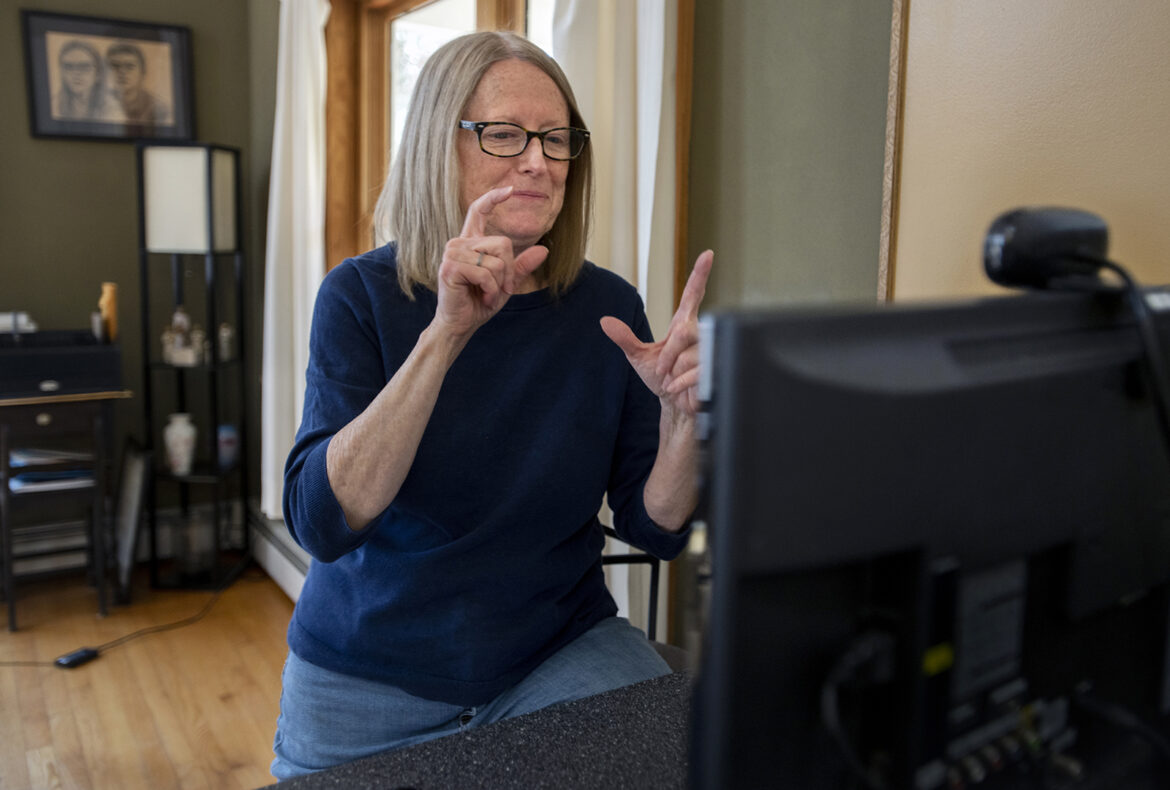
Doreen Simons, a certified deaf interpreter, uses a video remote interpreting (VRI) service from her Farmington home.

Deaf residents report frequent issues with sign language interpretation at Connecticut hospitals and health care facilities, hindering their ability to understand medical care fully.

And though video remote interpreting (VRI) services are widely available at Connecticut hospitals, patients have reported mixed experiences with the technology.

The issues persist more than 30 years after passage of the Americans with Disabilities Act (ADA), which requires interpretation for patients and family members under the “effective communication” section of the law. In the last three years, the U.S. Attorney’s Office has negotiated four settlements with medical facilities in Connecticut for complaints related to communication with deaf patients.

“At one point, ADA and accessibility seemed to be very good,” said Marissa Rivera, an advocate with Disability Rights Connecticut (DRCT). “And now, in 2022, it has completely collapsed.”

The reasons are multiple and complex but often attributed to an ongoing interpreter shortage, which makes it hard to consistently secure in-person interpretation, especially during unplanned emergency room visits.

Read the rest at http://c-hit.org/2022/04/14/interpreter-shortage-challenges-appropriate-medical-care-for-deaf-patients.