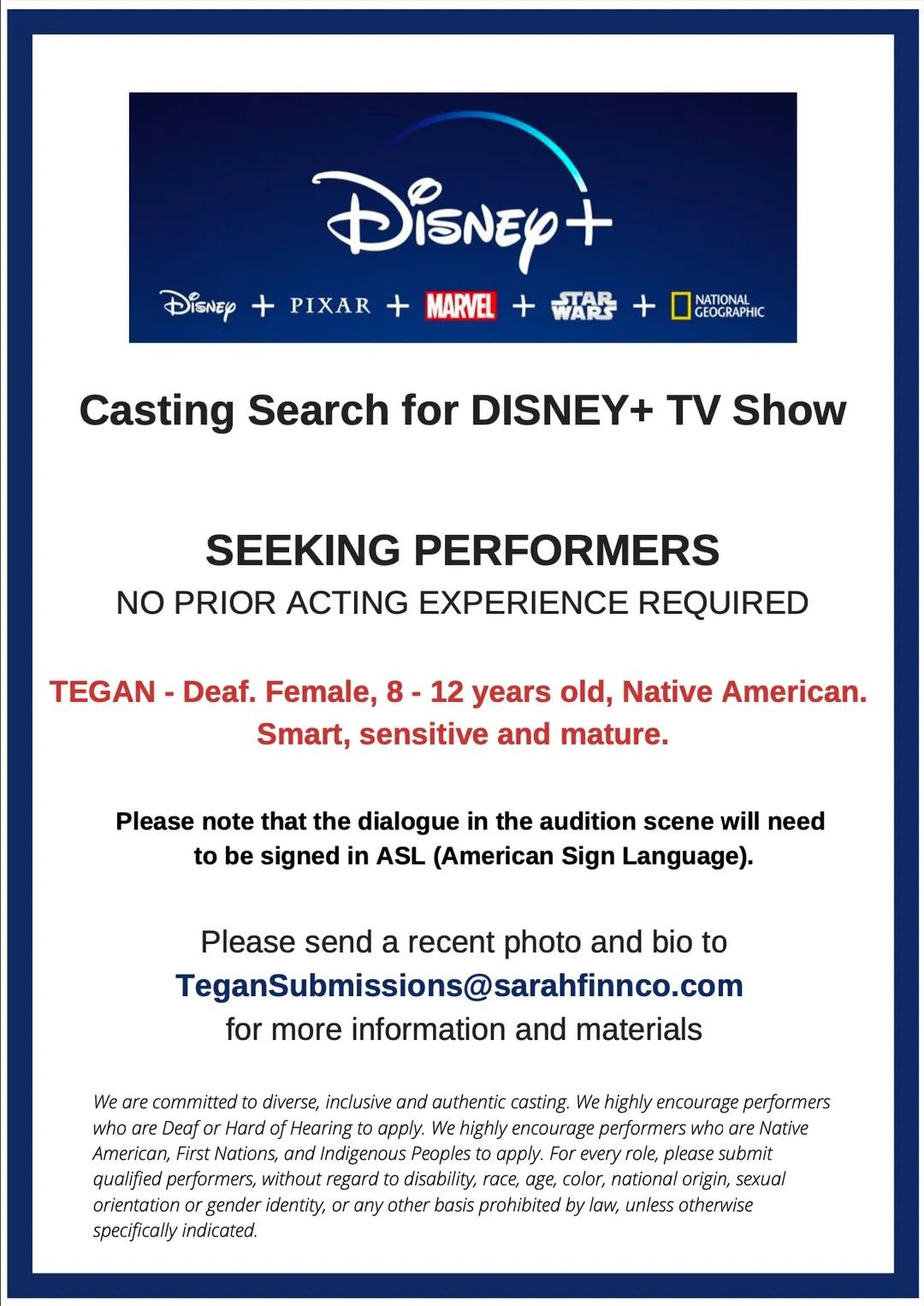
SEEKING PERFORMERS
NO PRIOR ACTING EXPERIENCE REQUIRED

Casting Search for DISNEY+ TV Show

TEGAN – Deaf. Female, 8 – 12 years old, Native American. Smart, sensitive and mature.

Please note that the dialogue in the audition scene will need to be signed in ASL (American Sign Language).

Please send a recent photo and bio to TeganSubmissions@sarahfinnco.com
for more information and materials

We are committed to diverse, inclusive and authentic casting. We highly encourage performers who are Deaf or Hard of Hearing to apply. We highly encourage performers who are Native American, First Nations, and Indigenous Peoples to apply. For every role, please submit qualified performers, without regard to disability, race, age, color, national origin, sexual orientation or gender identity, or any other basis prohibited by law, unless otherwise specifically indicated.

  • The Sarah Finn Casting Company

Recherche de casting pour l’émission de télévision DISNEY

CHERCHE INTERPRÈTES
AUCUNE EXPÉRIENCE PRÉALABLE N’EST REQUISE

TEGAN – Sourde. Fille âgée de 8 à 12 ans, amérindienne. Intelligente, sensible et mature.

Veuillez noter que les dialogues de la scène d’audition devront être signés en ASL (American Sign Language).

Veuillez envoyer une photo récente et une biographie à
TeganSubmissions@sarahfinnco.com
pour plus d’informations et de matériel

Nous sommes attachés à un casting diversifié, inclusif et authentique. Nous encourageons vivement les artistes sourds ou malentendants à postuler. Nous encourageons vivement les artistes-interprètes d’origine amérindienne, des Premières nations et des peuples indigènes à postuler. Pour chaque rôle, veuillez soumettre la candidature d’artistes qualifiés, sans considération de handicap, de race, d’âge, de couleur, d’origine nationale, d’orientation sexuelle ou d’identité de genre, ou de toute autre base interdite par la loi, sauf indication contraire.

  • The Sarah Finn Casting Company

Guidance on Web Accessibility and the ADA

This guidance describes how state and local governments and businesses open to the public can make sure that their websites are accessible to people with disabilities as required by the Americans with Disabilities Act (ADA).

Learn more about businesses’ and state and local governments’ ADA responsibilities.

Why Website Accessibility Matters

Inaccessible web content means that people with disabilities are denied equal access to information. An inaccessible website can exclude people just as much as steps at an entrance to a physical location. Ensuring web accessibility for people with disabilities is a priority for the Department of Justice. In recent years, a multitude of services have moved online and people rely on websites like never before for all aspects of daily living. For example, accessing voting information, finding up-to-date health and safety resources, and looking up mass transit schedules and fare information increasingly depend on having access to websites.

People with disabilities navigate the web in a variety of ways. People who are blind may use screen readers, which are devices that speak the text that appears on a screen. People who are deaf or hard of hearing may use captioning. And people whose disabilities affect their ability to grasp and use a mouse may use voice recognition software to control their computers and other devices with verbal commands.

The ways that websites are designed and set up can create unnecessary barriers that make it difficult or impossible for people with disabilities to use websites, just as physical barriers like steps can prevent some people with disabilities from entering a building. These barriers on the web keep people with disabilities from accessing information and programs that businesses and state and local governments make available to the public online. But these barriers can be prevented or removed so that websites are accessible to people with disabilities.

Read the rest at https://beta.ada.gov/web-guidance/?j=1437348&sfmc_sub=191084203&l=6707_HTML&u=32042776&mid=515008575&jb=0.

Ableism/Audism in Audiology Survey

The goal of this study is to assess the preparedness of audiologists to work with people with disabilities from the view of persons served, audiologists, and audiology education programs. An audiologist is a professional involved in the diagnosing and treating of hearing loss, balance disorders, and disorders of the auditory pathway. The project is being conducted by Jessica Krause under the supervision of Dr. Evelyn Davies-Venn at the University of Minnesota Twin Cities. This survey is intended to be taken by disabled individuals or their caregivers. 

 
The survey will take about 10 minutes to complete. There will be mostly multiple choice questions. Some questions will ask you to rank how much you agree/disagree with a statement. There are a few open answer questions. We will ask a mix of basic demographic information, and your views of the field of audiology as a whole as it relates to serving people with disabilities. You will be allowed to skip any questions aside from the screening and demographic questions. At the end of the survey, you will have the option to enter your email address to be entered in a drawing for a $50 Amazon e-gift card. Your email will not be linked to your responses. Your responses will be entirely anonymous. 
 
 All of your information will be kept confidential. All of the data is stored in a password protected electronic format. To help protect your confidentiality, the surveys will not contain any information that could personally identify you. The results of this study will be used for scholarly purposes only, data will not be shared or sold. Your participation in this study is entirely voluntary. You may choose not to participate and you will not be penalized. If you decide to participate, you may choose to withdraw at any time. Please know that only those who complete the survey will be entered in the drawing for the $50 Amazon e-gift card. 


Survey link – https://umn.qualtrics.com/jfe/form/SV_73btFMxsooeHUnI.