


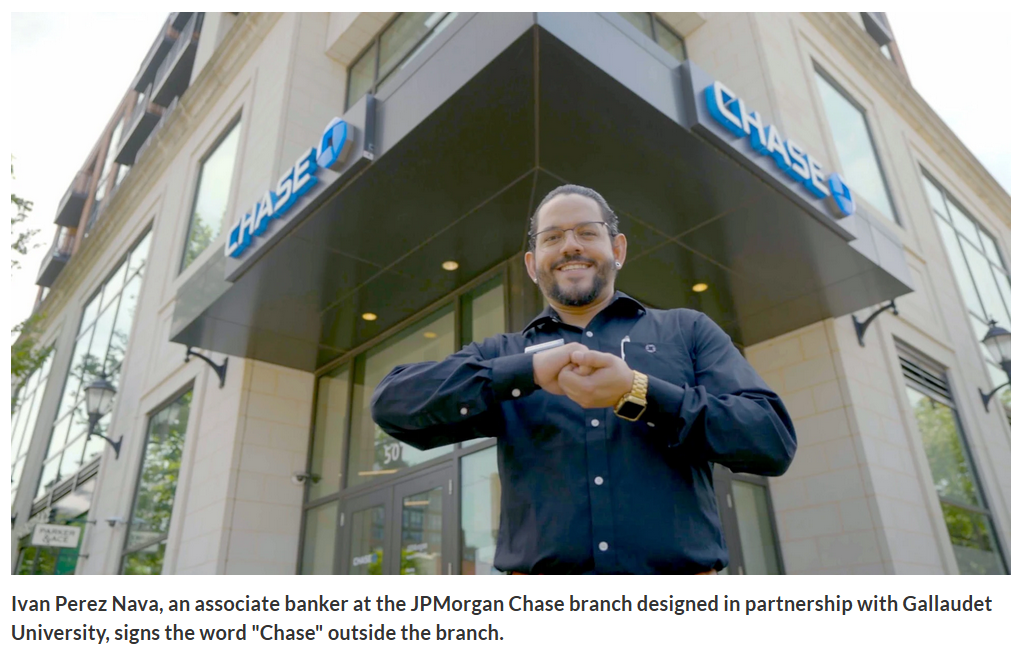
Banks are finding creative ways to make their “offline” services — from branches to debit cards to contact centers — more accessible to people with disabilities.
They are using technology to go beyond their responsibilities under Title III of the Americans with Disabilities Act, which prohibits discrimination based on disability in “places of public accommodation.” JPMorgan Chase designed a branch that prioritizes the needs of customers who are deaf and hard of hearing, and introduced one of its key features into the bank’s other locations last year. Regions Financial in Birmingham, Alabama, upgraded the wheelchair lift in its portable branch when it replaced its old vehicle in 2019. A challenger bank in Turkey developed a debit card that gives users a verbal heads-up on what they are about to spend.
These advances are significant because digital banking has replaced only some of the needs for customers with disabilities to navigate branches, ATMs, contact centers and in-store spending. Moreover, “Disability impacts all of us, either temporarily or permanently,” said Marsha Schwanke, a specialist at the Southeast ADA Center, which provides technical guidance on the ADA.
Some traditional bank spaces are lacking in this regard. An April report from Deloitte about how banks can better serve people with disabilities surveyed 1,000 people who self-identified as having a disability and 1,000 caregivers. About half said that banks could elevate their experience with assistive technologies. These could include Braille keypads, larger screens, more ergonomically designed keypads, voice-to-text or text-to-voice tools and specialized software for those with autism spectrum disorders, said Val Srinivas, banking and capital markets research leader at Deloitte. Also important to this community are evening and weekend hours that extend the time that caregivers can accompany their clients to physical locations.
Here are five notable ways that banks are removing barriers to customers with disabilities.

Five years ago, Paul Simon said he was finished writing songs. But he couldn’t stop. “To write a line that you like, and just one second before, it didn’t exist? You get, like, a big dopamine splash in your brain and you love it,” he said. “That’s why you keep doing it, ’cause it’s addictive.”
Lately, Simon’s been working on his ranch in the Lone Star State.
Mason said, “A lot of people would not have imagined that a boy from Queens would end up in Texas Hill Country?”
“Well, you have to marry a girl from Texas!” Simon replied.
He and his wife, the singer Edie Brickell, moved here recently. His latest solo album, “Seven Psalms,” was recorded in his cabin studio.
Read the rest at https://www.cbsnews.com/news/paul-simon-on-seven-psalms-and-hearing-loss/?fbclid=IwAR0rdYmePyeuJLNiEpUfOGmK3oiyYCMoePMy2c3bGWrACo2XbK54i6PevEY.