Survey: Deaf Culture Education for Healthcare Providers

Survey icon - showing clipboard with 2 check boxes, pencil on left side and person on lower right corner.

My name is Sidney Baker. I am a genetic counseling student at The University of Kansas Medical Center. I am reaching out to seek participants for a survey to help better accommodate the Deaf community in healthcare settings. My goal is to shift toward a cultural model of care that views deafness as a unique heritage and linguistic identity rather than a medical model. I aim to gather insights directly from the community to educate genetic counselors on Deafhood, cultural competency, and the history of the community to provide affirming and respectful care.

Please feel free to forward this email to anyone who identifies as Deaf, Hard-of-Hearing, Late-Deafened, or DeafBlind who uses American Sign Language (ASL), Black American Sign Language (BASL), or other visual/tactile communication methods as a preferred form of communication.

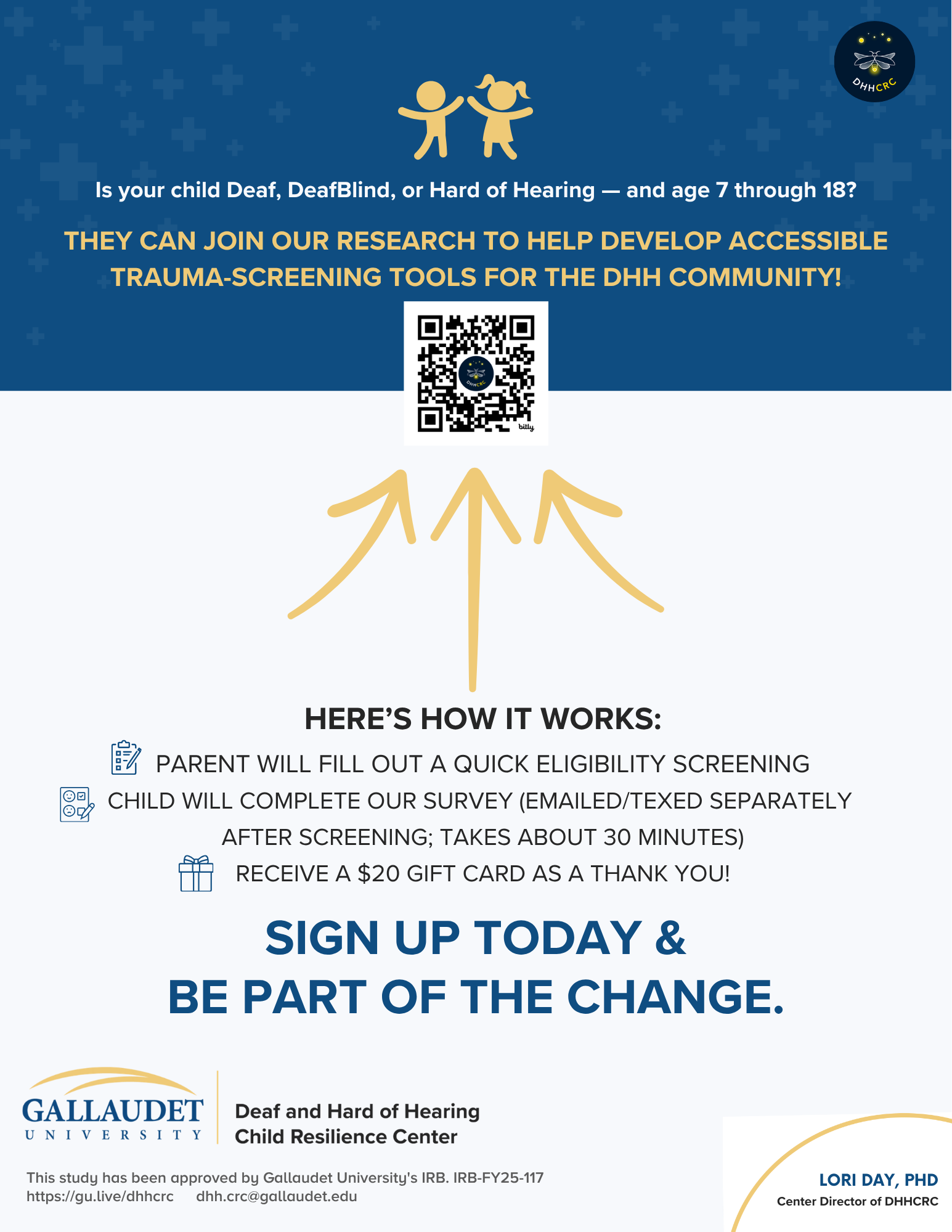
There are videos embedded in the survey describing the study, signed in ASL by a Certified Deaf Interpreter. I also have a flyer with more information and a QR code if needed. The survey can also be accessed by the link below: https://redcap.kumc.edu/surveys/?s=HM9TAK3YPF8D4D97

Please let me know if you have any questions. Thank you so much and have a great day!
 

Office of Workers’ Compensation Programs seeks public input on occupational hearing loss evaluation methods

United States Department of Labor logo

WASHINGTON – The U.S. Department of Labor’s Office of Workers’ Compensation Programs is inviting public comment on the comparative reliability and validity of hearing testing methods and best practices for evaluating occupational hearing loss. 

In a request for information, the OWCP is asking for input from audiologists, otolaryngologists, medical professionals, medical associations, employees, employers, insurance carriers, and other interested parties on the reliability and validity of audiograms compared with other objective tests, including the auditory brainstem response, auditory steady state response, otoacoustic emissions, and others. The agency is also soliciting comments on the current standards for administering these tests and the criteria used to evaluate hearing impairment.

Those interested in commenting should submit comments on www.regulations.gov, and include the agency name and regulatory information number for this rulemaking in their submissions. Commenters should not include personally identifiable information or confidential business information that they do not want publicly disclosed. Written comments must be received by Oct. 22, 2026. 

The rulemaking docket, background documents, and all submitted comments will be available at www.regulations.gov. Although some materials, such as copyrighted material, may not be available through the website, the complete rulemaking record will be available for inspection at OWCP.

Read the request for information.  <– The comment form can be found here too.  

Agency: Office of Workers’ Compensation Programs
Date:  June 23, 2026
Release Number: 26-988-NAT
 
 
DAD Note: Comments are due by October 22, 2026.  The plan is to update current testing standards for workplace hearing loss and compensation.